%20(1).jpg?width=2752&height=1548&name=20230406_120447%20(1)%20(1).jpg)
Exporting salmon to 150 countries is quite different from managing regional sales. As Norwegian seafood companies expand their reach and consolidate through acquisitions, they often find that the ERP systems they started with were never designed for this level of global complexity.
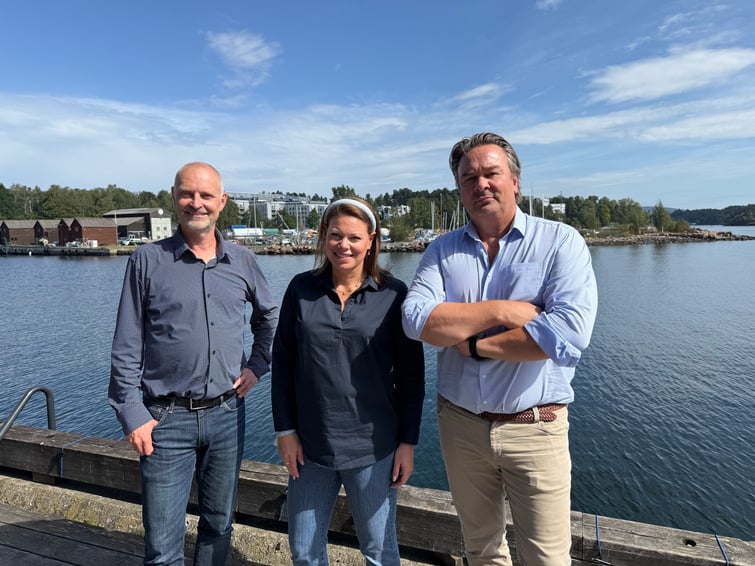
“Seafood companies are becoming larger and more professional. And when companies grow, the systems must grow with them,” says Christine Møller-Christensen, Solutions Architect Seafood Industry at Pearl Norway, who has spent more than a decade in the sector.
A global reach requires global systems
While the seafood industry may not be enormous in terms of the number of companies, it is inherently global. Norway is the world’s largest net exporter of seafood, which requires an infrastructure that can support operations far beyond national borders.
Arne Lie Gundersen, Head of Seafood Industry at Pearl Group, has spent more than 20 years building software companies in this specific niche.
“When you export to more than 150 countries, your systems must be able to handle a global business,” says Lie Gundersen.
Despite this global reach, many seafood companies still rely on local or industry-specific systems that were originally designed for less complex operations.
Fragmented systems and the AI challenge
Today, many seafood companies operate with a patchwork of specialised tools for trading, production, logistics, and finance. While these solutions might work well in isolation, they often create a fragmented landscape where data is trapped in silos. An integrated ERP suite offers a significant advantage over these solutions, especially as companies merge and require a consistent overview of the entire group.
“SAP may not be the best in every single function, but they are the best when it comes to the whole. With Seafood by Pearl, we apply this global strength to the industry's specific needs” says Lie Gundersen.
There is also a growing interest in how AI can improve forecasting and production planning. However, the technology is only as effective as the data it can access.
“If you ask an AI agent a question based on inconsistent or fragmented data, you risk getting answers that are fast but incorrect. Without a unified foundation, the technology struggles to compare the right numbers,” says Møller-Christensen.
A unified platform simplifies this significantly, allowing companies to ask questions across the entire organisation and actually trust the results.
Increasing regulatory pressure
Traceability, ESG reporting, and supply chain regulations are continuously evolving, adding another layer of complexity.
“The challenge isn’t necessarily one big regulation. It’s that new requirements are constantly being introduced,” says Møller-Christensen.
For companies operating across multiple markets, this creates a constant need to adapt. This is where scale matters. A robust platform like SAP has the resources to respond quickly to new requirements, which creates a level of security for the companies using it.
Building a new vertical for seafood
Seafood by Pearl aims to combine deep industry knowledge with SAP’s global ERP platform. This combination of world-leading technology and niche expertise is a unique proposition in the market. To reduce the perceived risk for customers, Pearl is actively recruiting more industry veterans to work alongside their SAP specialists, ensuring the sector's specific needs are met.
“We are experts in SAP. But we are also experts in the ERP challenges that seafood companies face,” says Møller-Christensen.
Many companies are already familiar with SAP, but they want to see strong industry expertise before committing to a major transformation.
“Our goal is to create a solution designed for the seafood industry, not just a bespoke project for a single customer. By building a true vertical on SAP, we ensure that our customers stay on a global roadmap with continuous updates,” says Lie Gundersen.
For years, parts of the market have been dominated by a few specialised vendors. However, the industry is now looking for more choice and long-term scalability.
Is the seafood industry outgrowing its ERP systems? If the current growth trajectory continues, for many companies the answer is yes.